Marketing intelligence · Open-source reference implementation
From campaign inputs to a reviewable media plan
MIRA combines a free-text campaign brief with CRM and GA4 CSVs, coordinates research, audience, and performance analysis, then produces a sourced strategy document for review.
Workflow
- Accept a campaign brief and CRM and GA4 CSV inputs.
- Run research, audience, and performance analysis in parallel.
- Synthesize typed findings before the strategy model writes narrative.
- Allocate budget with deterministic response-curve logic.
- Persist the report and audit trace for review and Admin approval.
Control boundaries
- Supabase JWT is checked at the API boundary.
- Report and audit reads use the user's JWT so row-level security applies.
- Trusted backend writes happen only after route-level authorization.
- Budget numbers come from deterministic Python logic, not model-generated prose.
- Raw uploaded CSV data is parsed in memory; samples are synthetic.
Why separate the numbers from the narrative?
A strategy document can be easier to review when its recommendations have source references and its budget allocations come from a deterministic calculation. MIRA keeps allocation math in the response-curve service and asks the language model to write the surrounding sourced explanation.
The repository describes a reference implementation and local reviewer workflow. This page does not claim measured campaign performance, client results, or production deployment.
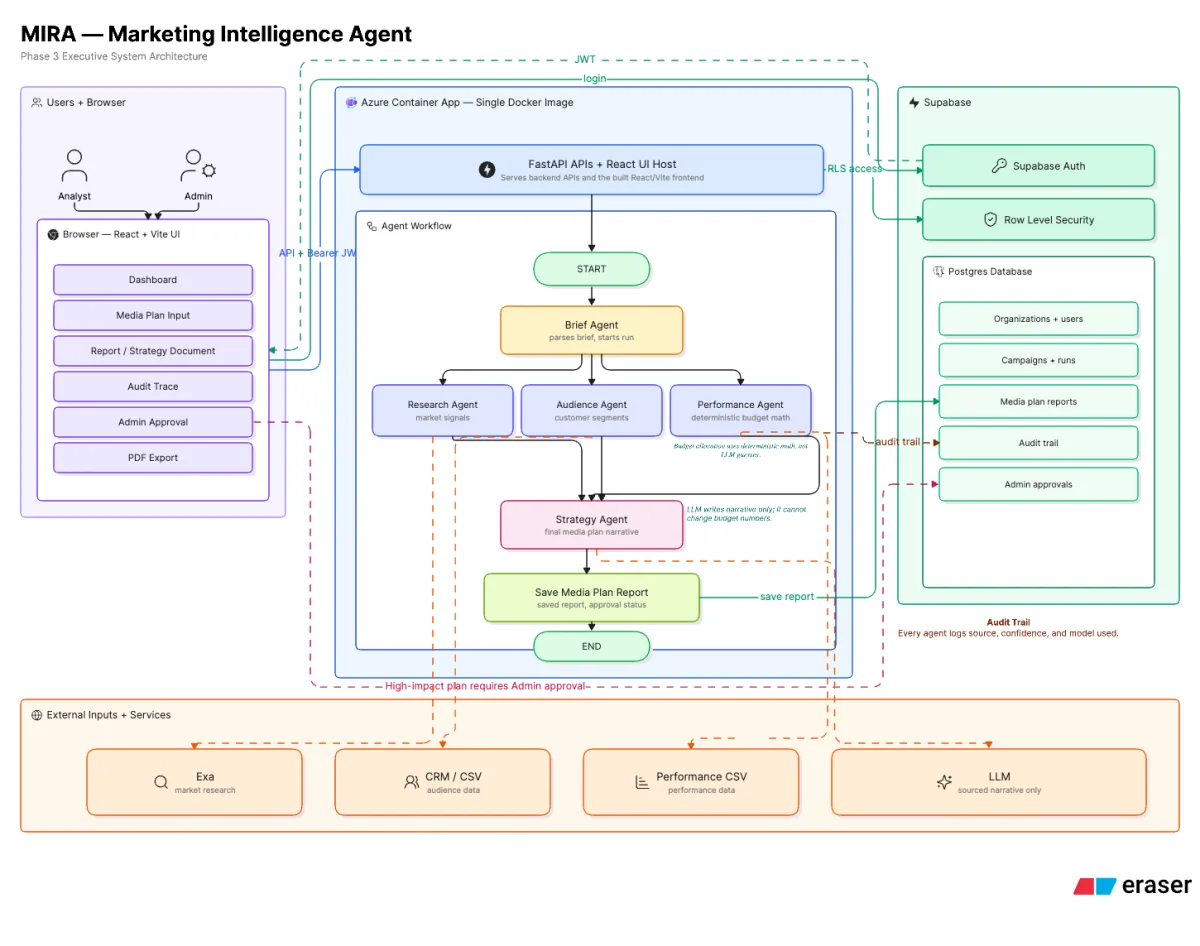
Security model
Browser-authenticated reads remain subject to Supabase row-level security. Generated records are written by the backend after route-level authorization. CSV uploads are capped at 2 MB each, and raw contents are not stored in reports or audit rows.
Repository
The public repository contains the application, synthetic sample inputs, validation commands, and security documentation.
github.com/georgeschamma/mira-agent